



Micro-hardness testing permits measuring the hardness of a material on a microscopic scale. The Qness Q60 A+ microindenter is a fully automated system with quick and precise positioning relative to the sample. The machine is equipped with three different magnification lenses (10X, 40X, and 65X) and three indenters (Vickers, Knoop and Brinell), which facilitate hardness measurements across a broad range of materials. Samples with varying heights and tilts can be indented at the same time with the Qness CAS sample holders. Additionally, the indenter can be adapted to the respective contour of the test sample such that different material regions (i.e. e.g. layers) can be tested precisely. Additionally, users can obtain the hardness distribution across a segment or whole plane of the test sample using the 2D/3D mapping tool.
With the Qness Q60 A+ microindenter, we are able to conduct the following hardness tests:
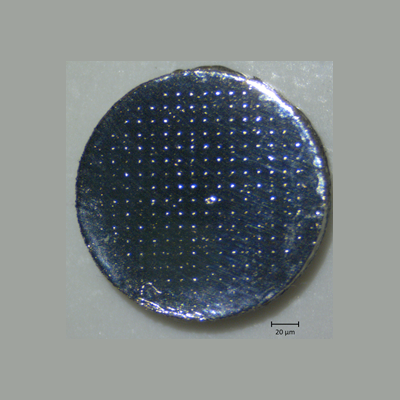
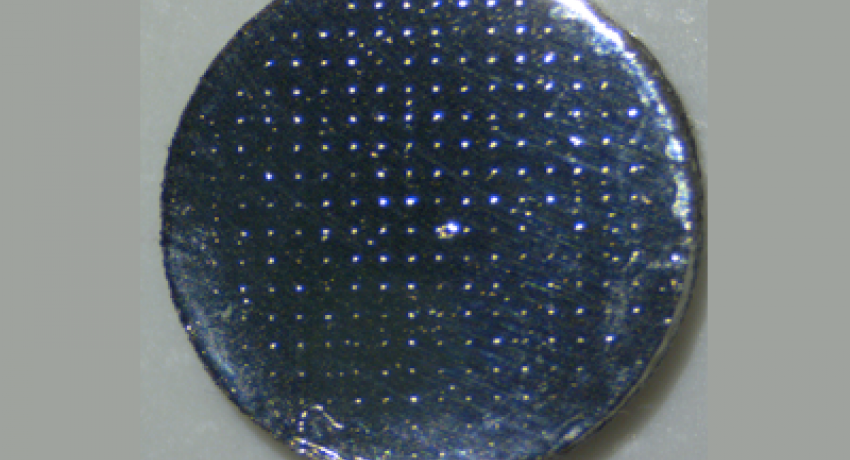
Sample polished to using 0.3 µm colloidal silica, showing the array of 200+ Vickers indents. The microindents were made using 0.3 kg of force using a 10 s indent duration (HV 30/10 test).

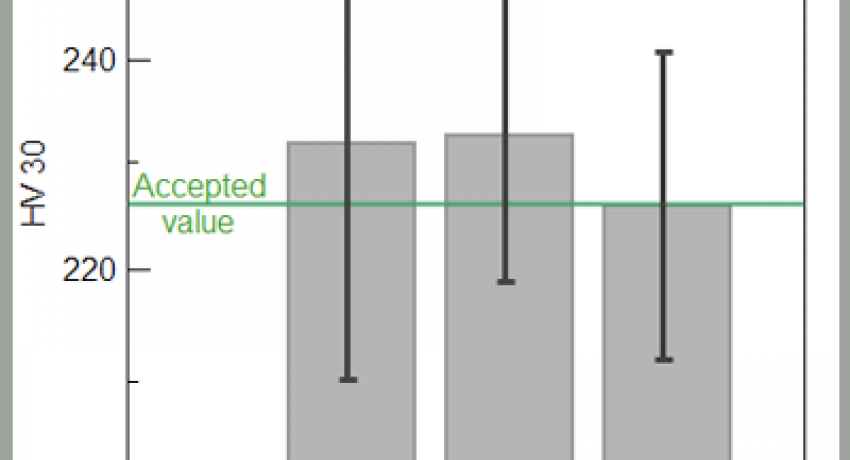
Plot showing the mean and standard deviation of the HV 30 hardness measurement for 316 stainless steel polished to different surface roughnesses. The 0.3 micron colloidal silica step results in the most accurate result (i.e. closest to the accepted 316 hardness value). The precision of the measurements, as noted by the error bars showing the standard deviation, are similar for the samples polished using 1,200 grit SiC sandpaper and 0.3 micron colloidal silica, and significantly better compared to the error for the 600 grit sample.


The nanoindenter is designed to measure the mechanical properties of surfaces on a submicroscopic scale. The indenter takes a small diamond probe, which is shaped as either a pyramid or a sphere and pushes the diamond tip into the surface of the material being tested. The depth of indentation can range from nanometer to a maximum of 4 microns. By measuring the force required to push the diamond tip into the material compared to the depth of the indentation, the instrument can determine the hardness of the sample. Seeing to what degree the material returns to its previous shape determines its elastic modulus - the stiffness of its atomic bonds.
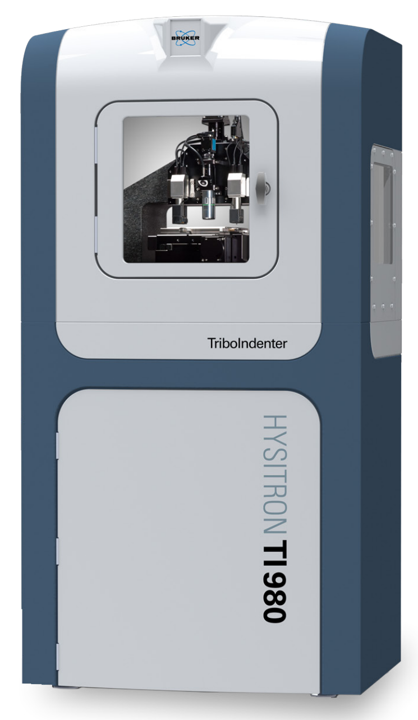
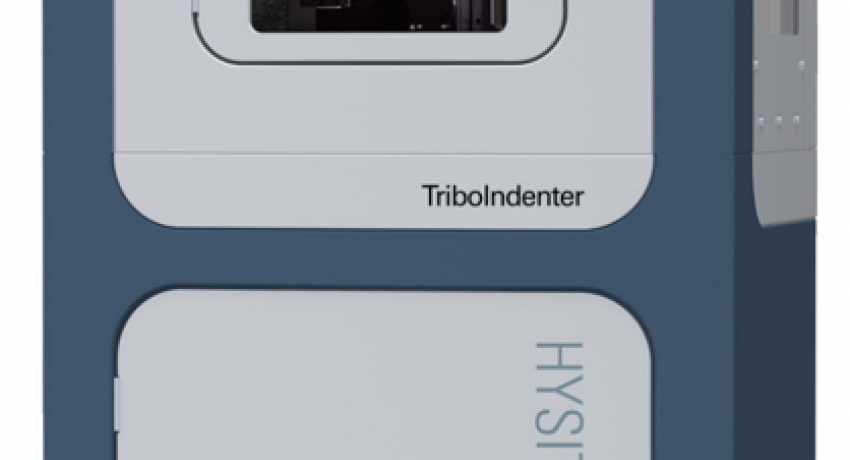
Bruker Hysitron TI-980
Sample Requirements/Specifications
- 1D normal force and 1D nanoDMA transducer assemblies.
- Samples must be smooth on both front and backside. Backside polish only needs to be good enough to hold vacuum or glued to metal disk for mounting on stage.
- Sample must be flat (less than 1 degree of tilt when loaded on stage).
- Sample Size: less than 10cm laterally, less than 4cm tall.
- Sample roughness will depend on indentation depth, less than 50nm is required.
- Maximum force is 10mN, maximum displacement in Z is 4μm.
- 1D Standard Nanoindentation.
- XPM - Accelerated Property Mapping.
- nanoDMA III Dynamic Nanoindentation.
- In-situ SPM Imaging.
| Z-axis | X-axis | |
| Maximum Force | 10 mN | 2 mN |
| Maximum Displacement | 4μm | 15μm |
| Load Noise Floor | 20 nN | 3.5 μN |
| Load Resolution | 1 nN | 50nN |
| Displacement Resolution | 0.006 nm | 0.02 nm |
| Displacement Noise Floor | 0.1 nm | 2 nm |
| Thermal Drift | Less tank 0.05 nm/sec | Less than 0.05 nm/sec |