Yinming Shao
(e) ymshao@psu.edu
341 Davey Laboratory
(e) ymshao@psu.edu
341 Davey Laboratory
By Adrienne Berard
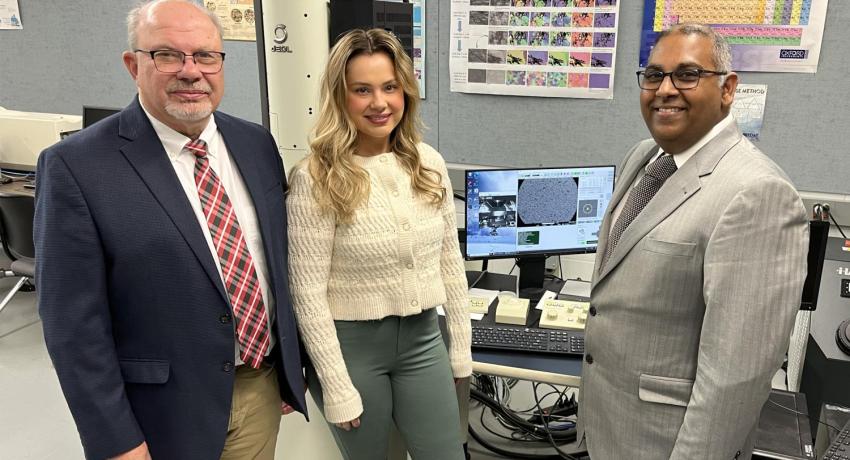
The U.S. Department of Energy (DOE) announced today (Sept. 4) that it will continue to support Penn State’s Center for Three-Dimensional Ferroelectric Microelectronics Manufacturing (3DFeM) as an Energy Frontier Research Center.
By Sarah Small
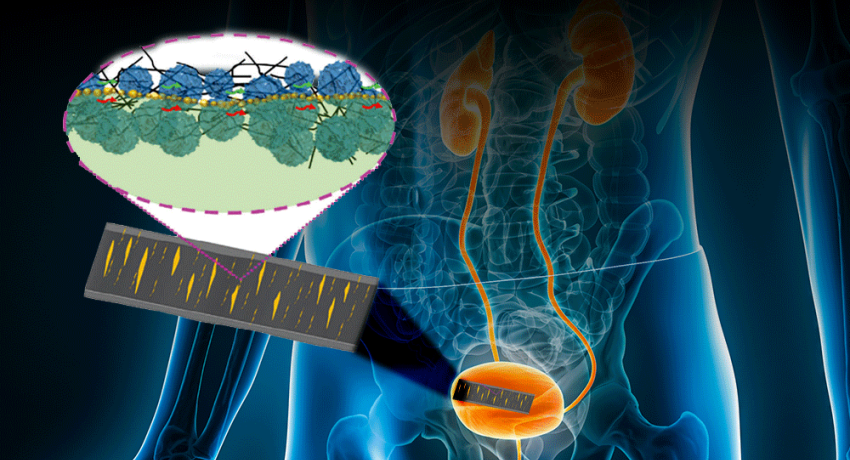
To advance soft robotics, skin-integrated electronics and biomedical devices, researchers at Penn State have developed a 3D-printed material that is soft and stretchable — traits needed for matching the properties of tissues and organs — and that self-assembles. Their approach employs a process that eliminates many drawbacks of previous fabrication methods, such as less conductivity or device failure, the team said.
They published their results in Advanced Materials.
By Jamie Oberdick
A discovery that uncovered the surprising way atoms arrange themselves and find their preferred neighbors in multi-principal element alloys (MPEA) could enable engineers to “tune” these unique and useful materials for enhanced performance in specific applications ranging from advanced power plants to aerospace technologies, according to the researchers who made the finding.
221 AMIC Building
Penn State Behrend
5350 Technology Drive
Erie, PA 16510
(e) jqz5665@psu.edu
(p) 814-898-6562
Researchers develop a robust quantum highway with switch to control electron movement
By Ashley WennersHerron
By Jamie Oberdick
Transition metal carbides (TMCs) and transition metal dichalcogenides (TMDs) are emerging as key players with transformative potential across various industries. Originally recognized for their industrial applications like solid-state lubrication, these materials are now the focus of cutting-edge research aimed at revolutionizing electronic devices and catalytic processes.
By Mariah Lucas
Rechargeable solid-state lithium batteries are an emerging technology that could someday power cell phones and laptops for days with a single charge. Offering significantly enhanced energy density, they are a safer alternative to the flammable lithium-ion batteries currently used in consumer electronics — but they are not environmentally friendly. Current recycling methods focus on the limited recovery of metals contained within the cathodes, while everything else goes to waste.