Man standing in lab next to buckets

The Penn State Bakery has long supported the University community through baked goods and desserts. Now, with a system developed by…

The advanced sensors and cameras that power self-driving cars struggle to adapt to changing lighting. A team of researchers, co-led by an engineer at Penn State, is taking inspiration from human biology to potentially solve this problem. Credit: Andrey Rykov/Getty Images. All Rights Reserved.

By Ty Tkacik

Although self-driving cars and sophisticated robots use advanced cameras, computer algorithms and artificial…

two people loading a sample in a lab

The Materials Characterization Lab (MCL), part of the Materials Research Institute (MRI) at Penn State, is partnering with two…

 EEG electrodes are placed through hair during testing of a biogel designed by Penn State researchers to improve contact with the scalp for wearable brain-monitoring systems. The reusable material softens with gentle heat, reaches the skin and gels again as it cools.

By Jamie Oberdick

UNIVERSITY PARK, Pa. — A vital tool for healthcare practitioners, electroencephalography (EEG) systems measure…

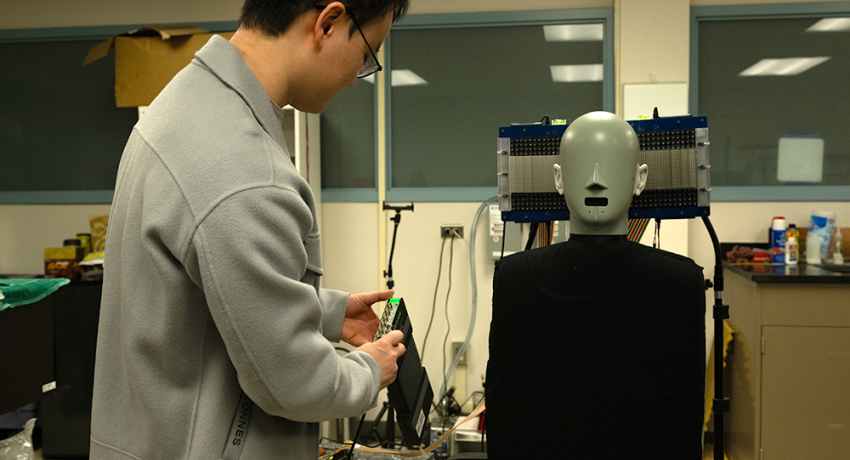
Researchers from Penn State have created a 3D-printed speaker covering that can tightly focus sound waves into a tiny point in space, like a magnifying glass focusing a beam of light.

Music lovers may one day be able to blast their favorite artists, headphone-free, without angering the neighborhood or colleagues,…

image of a sensor on a finger

High blood pressure, formally known as hypertension, is a leading cause of heart disease in the United States, impacting nearly half of…

Herbert A McKinstry, age 86

By Jamie Oberdick

Herbert A. McKinstry, a pioneering materials scientist, educator, community activist and founding faculty…