3D-printed speaker cover can focus audio into a private ‘sound spot’

Music lovers may one day be able to blast their favorite artists, headphone-free, without angering the neighborhood or colleagues, thanks to researchers at Penn State.

Music lovers may one day be able to blast their favorite artists, headphone-free, without angering the neighborhood or colleagues, thanks to researchers at Penn State.

Wearable electronics could be more wearable, according to a research team at Penn State. The researchers developed a scalable, versatile approach to designing and fabricating wireless, internet-enabled electronic systems that can better adapt to 3D surfaces, like the human body or common household items, paving the path for more precise health monitoring or household automation, such as a smart recliner that can monitor and correct poor sitting habits to improve circulation and prevent long-term problems.

Guha Manogharan, associate professor of mechanical engineering, will conduct the work through a subcontract with Southwest Research Institute
By Ty Tkacik
By Mariah Lucas
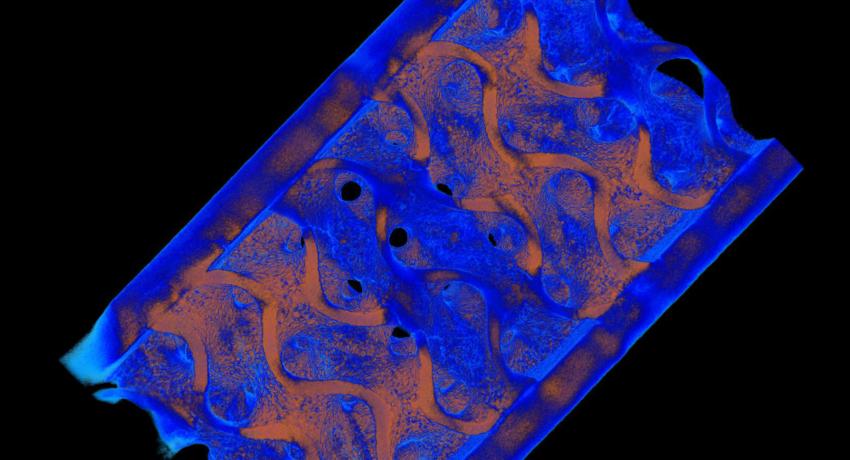
A team of Penn State researchers used a new 3D-printing method to produce a complex metal build that was once only possible with welding: fusing two metals together into a single structure.
By Ashley WennersHerron
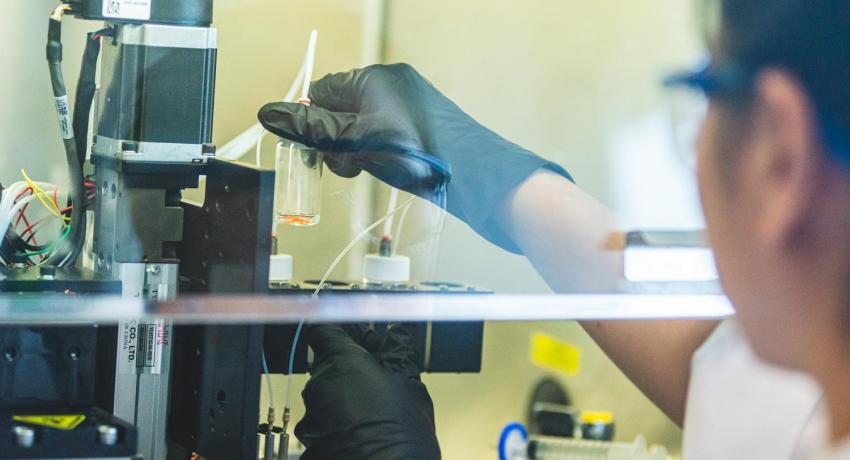
Fat tissue holds the key to 3D printing layered living skin and potentially hair follicles, according to researchers who recently harnessed fat cells and supporting structures from clinically procured human tissue to precisely correct injuries in rats. The advancement could have implications for reconstructive facial surgery and even hair growth treatments for humans.
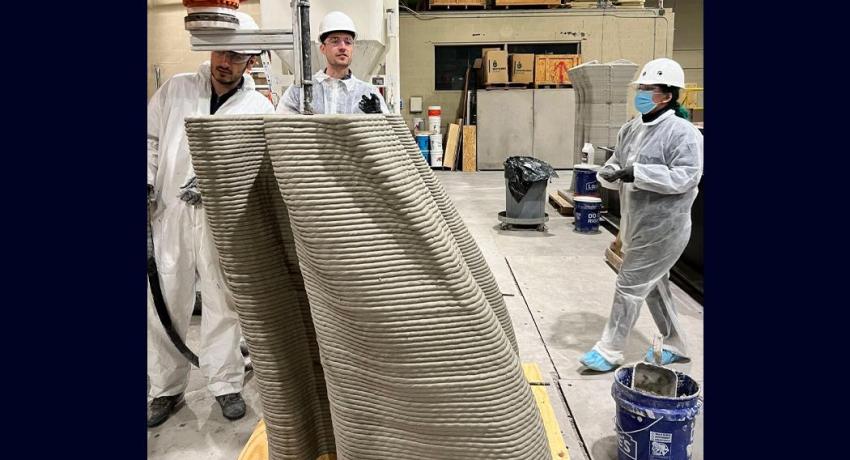
Alaska needs an estimated 27,500 new housing units over the next 10 years to alleviate overcrowding and unsanitary conditions, according to the Alaska Housing Foundation Corporation. An interdisciplinary team of Penn State researchers led by José Pinto Duarte, Stuckeman Chair in Design Innovation and director of the Stuckeman Center for Design Computing (SCDC) in the College of Arts and Architecture’s Stuckeman School, is looking to alleviate some of that stress with a $376,000 U.S. Department of Housing and Urban Development (HUD) grant.

By Jeff Mulhollem
USDA grant to fund Penn State researchers developing new and sustainable materials from lignocellulosic biomass
A sustainable resin material comprising agriculturally derived components could potentially replace plastics used in large-format 3D printing, which can produce furniture, boats and other similarly sized objects, according to a team of Penn State agricultural and biological engineers.
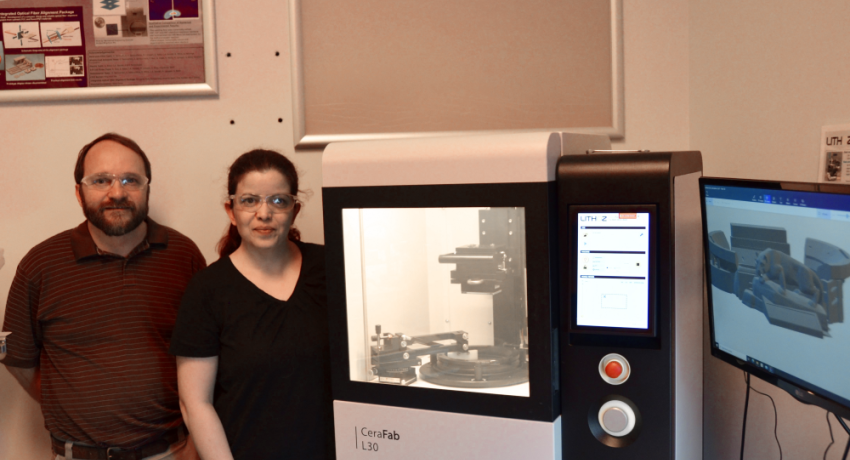
UNIVERSITY PARK, Pa. — A recently installed 3D ceramics printer offers Penn State materials researchers advanced capabilities to easily produce high-resolution ceramic parts and other innovative ceramics for cutting-edge materials research at a lower cost than sourcing them.
By Sarah Small
Acoustic waves may be able to control how particles sort themselves. While researchers have been able to separate particles based on their shape — for example, bacteria from other cells — for years, the ability to control their movement has remained a largely unsolved problem, until now. Using ultrasound technology and a nozzle, Penn State researchers have separated, controlled and ejected different particles based on their shape and various properties.