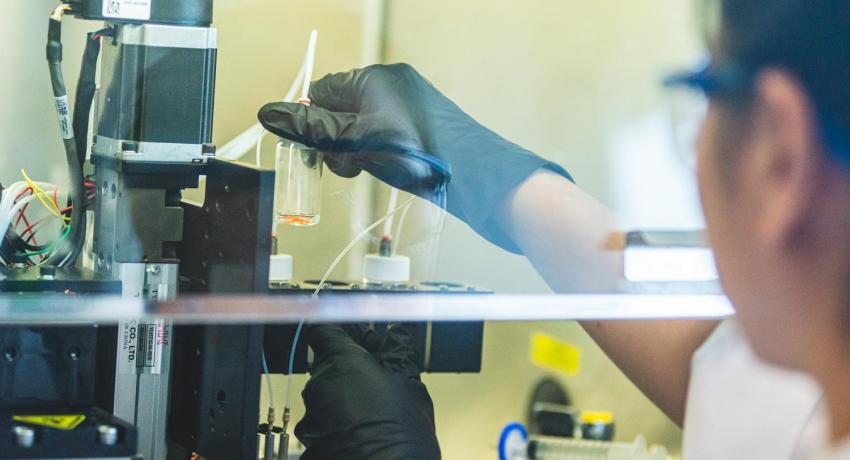
February 5, 2012 - For the first time, a group of chemists, physicists, and engineers has developed crystalline materials that allow an optical fiber to have integrated, high-speed electronic functions. The potential applications of such optical fibers include improved telecommunications and other hybrid optical and electronic technologies, improved laser technology, and more-accurate remote-sensing devices.
(Photo Credit: Badding Laboratory, Penn State)
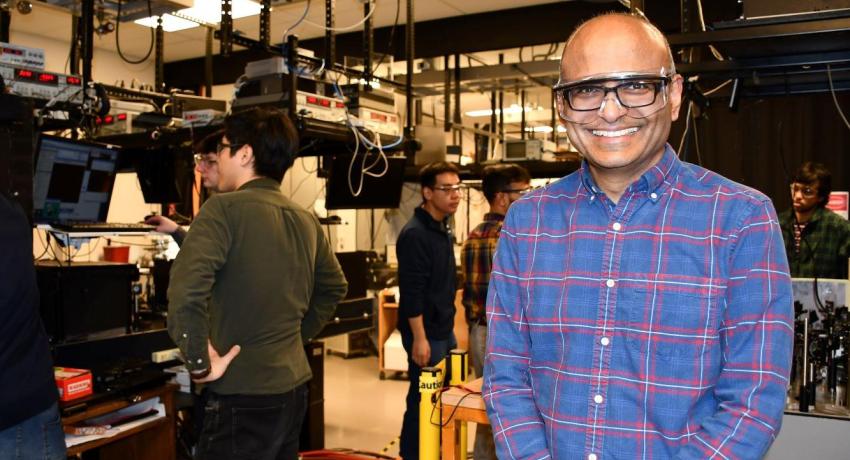
January 11, 2012 - When Penn State's Millennium Science Complex opened its doors to researchers this fall, it inaugurated a new era of scientific discovery at the intersection of materials science, engineering, nanoscience and the life sciences at Penn State. (Photo Credit: Tim Tighe, Penn State)
December 13, 2011 - A new chemical technique for depositing a non-crystalline form of silicon into the long, ultra-thin pores of optical fibers has been developed by an international team of scientists in the United States and the United Kingdom. The technique, which is the first of its kind to use high-pressure chemistry for making well-developed films and wires of this particular kind of silicon semiconductor, will help scientists to make more-efficient and more-flexible optical fibers. (Photo Credit: John Badding Lab, Penn State)
December 19, 2011 - "I wanted to let you know that we are making a significant change to our IP policies at Penn State - we will no longer insist on owning the Intellectual Property that issues from industry sponsored research." -- Henry C. Foley, Ph.D., Vice President for Research & Dean of the Graduate School
December 16, 2011 - Penn State has made significant changes to its intellectual property policies. Effective Friday (Dec. 16), intellectual property that results from industry-sponsored research no longer is mandated to be owned by the University.
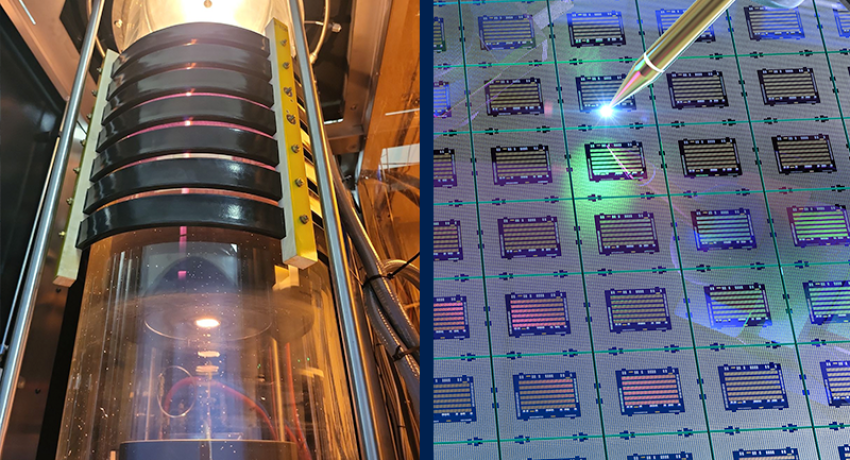
December 9, 2011 - Controlling power consumption in mobile devices and large scale data centers is a pressing concern for the computer chip industry. Researchers from Penn State and epitaxial wafer maker IQE have created a high performance transistor that could help solve one of the vexing problems of today's MOSFET technology - reducing the power demand whether the transistors are idle or switching. (Photo Credit: Penn State)
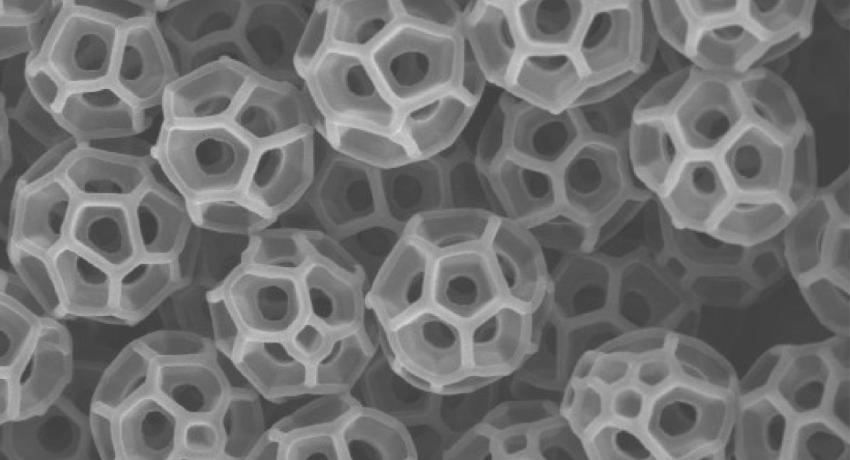
December 1, 2011 - Researchers in the Department of Materials Science and Engineering and the Materials Research Institute at Penn State are part of a multidisciplinary team of researchers from universities and national laboratories across the U.S. who have fabricated piezoelectric thin films with record-setting properties. These engineered films have great potential for energy harvesting applications, as well as in micro-electro-mechanical-systems (MEMS), micro actuators, and sensors for a variety of miniaturized systems, such as ultrasound imaging, microfluidics, and mechanical sensing. (Photo Credit: Trolier-McKinstry, Penn State)
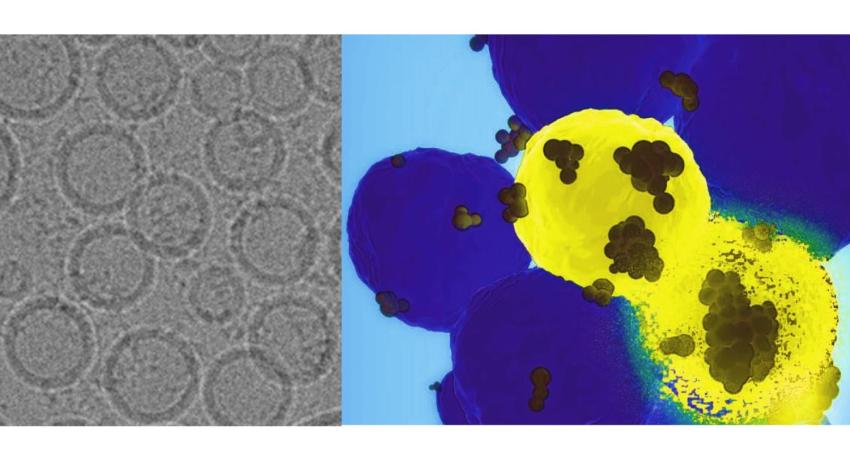
September 19, 2011 - The most efficient colloidal-quantum-dot solar cell ever created will be described in a scientific paper to be published in a print edition of the journal Nature Materials by a team of scientists that includes John Asbury, assistant professor of chemistry at Penn State University. (Photo Credit: Sargent Lab, University of Toronto.)
The Millennium Science Complex enables Penn State scientists and engineers to conduct research at the frontiers of 21st century science, with an emphasis on interdisciplinary research in materials and the life sciences.
Learn More >>